
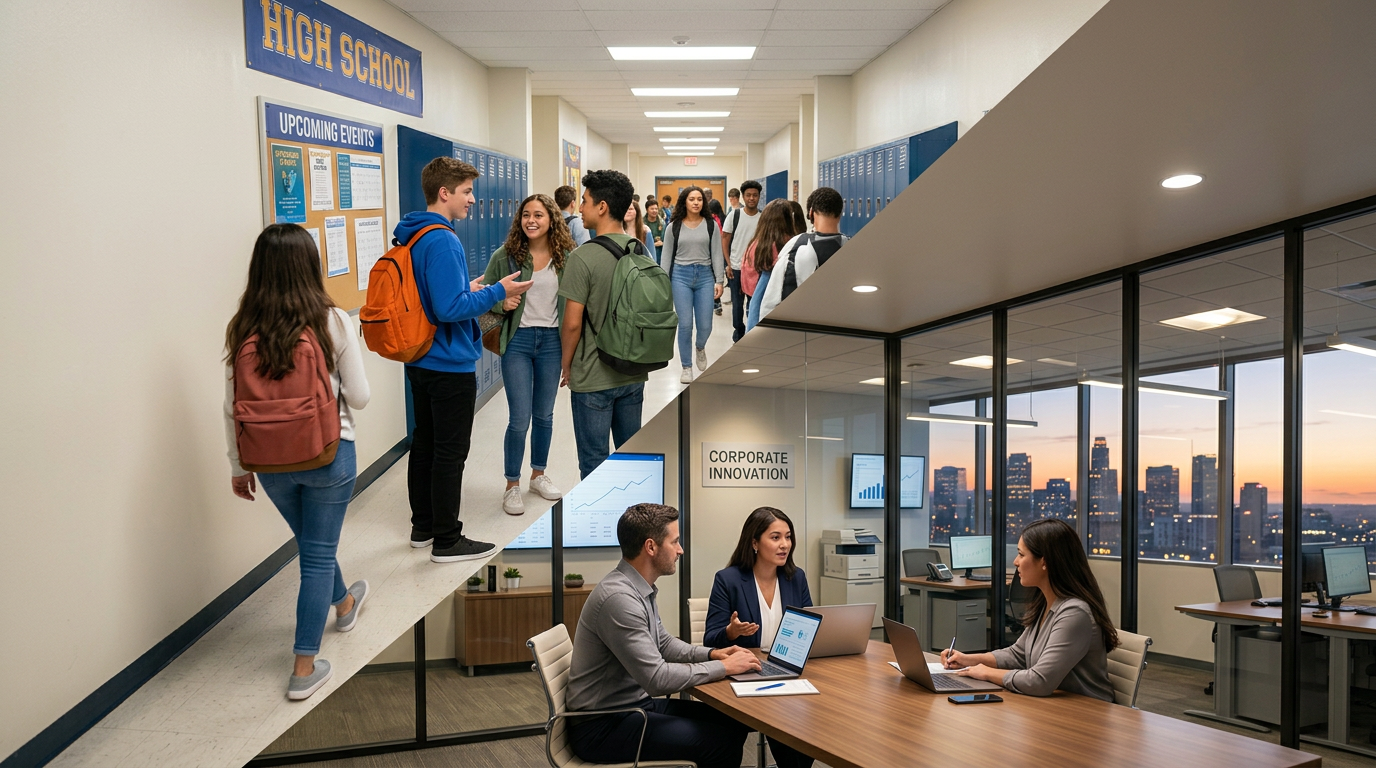
The last corporate leadership workshop I attended had a breakout session on psychological safety. The facilitator called it a breakthrough concept. I smiled — because I’d spent the better part of two decades as a school principal, building it into every staff meeting, every coaching cycle, and every difficult conversation with a struggling teacher.
Education got there first.
I’m Brent Anderson, an Implementation Strategist at AVID Center who has spent 25+ years working with K-12 schools and districts — and who has spent the last several years making a deliberate move into corporate leadership development. I’ve sat in both rooms. I’ve watched both systems struggle with the same fundamental question: How do I get the best work out of people in service of a larger mission?
I’ve also watched Dr. Christie McMullen, host of the Productive Joy podcast, do the same thing — taking what she spent years teaching educational leaders and bringing it directly to corporate partners. Her core premise is simple and stubborn: people do better work when they feel better doing it. That’s not a soft idea. That’s organizational strategy.
What Christie and I have both noticed is that the corporate L&D world keeps “discovering” practices that schools have been running for years. They arrive with new names, new acronyms, and new price tags. And while the context absolutely matters — a classroom is not a boardroom — the principles behind the practices transfer powerfully.
Here are three you’ve probably seen on your radar lately.
Instructional Coaching → Executive Coaching
Corporate America is spending thousands of dollars on executive coaching, often delivered in isolated engagements far removed from the actual work.
K-12 has embedded instructional coaching into schools for decades. These are master teachers, often called Instructional Coaches or Teachers on Special Assignment, who provide regular, job-embedded, non-evaluative support to teachers across the experience spectrum. They don’t show up once a quarter with a framework. They’re in the building. They build collegial relationships. They listen with empathy. They bring current research on pedagogy directly into a teacher’s practice through modeling, co-creating, and ongoing feedback.
On a Monday morning, an instructional coach might be pulled aside by a teacher who had a new idea — and wants to try it in ten minutes. Together, they redesign the lesson in real time, right there in the hallway. That doesn’t happen in executive coaching.
The architecture of great coaching has always been the same. The question is whether it’s a “perk of the job” or built into the system.
Professional Learning Communities (PLCs) → Peer Learning Cohorts
Rick DuFour began the conversation around PLCs in the 1990s. His insight was elegant: the best professional learning happens when experts talk — in a structured, focused way — about the work they are doing every day. Not a wandering staff meeting. Not a lecture from a consultant. A disciplined conversation among practitioners who respect each other’s experience.
Corporate L&D is now buzzing about “cohort-based learning” and “peer accountability circles.” This is the same architecture. It is a different acronym. And there’s nothing wrong with that — good ideas should travel. But let’s be clear about where they came from.
It’s Wednesday. The 9th-grade algebra team is meeting. Recent quiz data shows that most students are struggling with factoring trinomials, but one teacher’s students outperformed the rest. The team doesn’t debate or defer to administration. They ask that teacher what worked, and they rebuild their re-teaching plan together before the bell rings.
Social-Emotional Learning & Trauma-Informed Practice → Psychological Safety & Whole-Person Leadership
This is the one that stops corporate leaders cold when I explain it.
Social-Emotional Learning and trauma-informed practices in schools are built on a foundational premise: every person who walks through the door arrives with a history, a stress response, an emotional life, and all of it affects their ability to learn and perform. You don’t get to the academic content until you’ve addressed the human being in front of you. Educators built this into curriculum, into classroom culture, into the way they structured feedback and handled conflict.
Corporate L&D now calls this psychological safety, empathetic leadership, and whole-person wellness. It is the same premise with a different vocabulary. And businesses are still trying to build it into culture, while schools have been living it in practice for a generation.
I’ve seen it proven across hundreds of schools and now in corporate settings as well: this isn’t about making people comfortable. It’s about making them capable. Safety is the precondition for performance.
What This Means for You
The understanding that corporate L&D tends to follow trends that K-12 pioneered is not a critique — it’s an opportunity. The map already exists. You just need someone who has navigated both territories.
Whether you’re trying to shift workplace culture, arrest employee turnover, move an initiative to scale, or maximize your return on investment in people, the frameworks exist. The research is deep. The practice is proven.
If any of this resonates — if you’re reading this and nodding about your own organization — I’d love to continue the conversation. Connect with me at livelearnandlead.com or find me on LinkedIn.
The school bell is about to ring for summer. Let’s talk about where you’re headed.
Leave a Reply